I used to think that creating good content was relatively straightforward.
You research a topic, write something informative, make it visually appealing, optimize it for search engines, and publish it.
Of course, there’s a lot of work involved in those steps. But the general idea seems simple enough.
Good content should be accurate, engaging, and useful.
Right?
Well, apparently, there’s a little more to it.
During my Master’s in Content Strategy at FH JOANNEUM, I was introduced to a perspective that made me question how I’d been approaching content creation.
One of my lecturers, Rahel Anne Bailie, has spent years working with organizations to help them manage content more strategically. In her publication Content Integrity Model: A Framework for Sustainable, Scalable, AI-Usable Content(2026), she explores an idea that I find particularly relevant to today’s digital environment.
Content quality isn’t simply about what people see.
It’s also about everything happening behind the scenes that allows that content to remain accurate, accessible, reusable, and valuable over time.
And the more I thought about it, the more I realized how much this connected to my own experience working in healthcare marketing.
Because when you’re responsible for writing blog articles, producing videos, managing social media, and maintaining website content, you quickly discover that publishing something is only one small part of the process.
The real challenge is making sure everything continues to work together.
We Spend So Much Time Making Content Look Good
There’s something satisfying about finishing a piece of content.
A video with smooth transitions.
A blog article with a compelling headline.
An Instagram carousel with carefully chosen typography.
You look at the finished product and think, Okay, this looks pretty good.
And sometimes it genuinely is.
But I’ve started wondering whether we place too much emphasis on the visible parts of content creation.
We evaluate content based on how it looks, how it reads, and how people interact with it.
Did the post receive enough likes?
Was the video engaging?
Did the article rank on Google?
These are reasonable questions.
But what about the questions we don’t always ask?
Who is responsible for updating the article when the information changes?
Can the content be reused without copying and pasting it into five different places?
Is it accessible to people with different needs?
Does the organization have a consistent way of managing terminology?
And perhaps most importantly, will this content still be useful six months from now?
These questions aren’t particularly glamorous.
Nobody is going to congratulate you on having excellent metadata.
But they matter.
And this is where Bailie’s Content Integrity Model becomes interesting.
What Is Content Integrity, Anyway?
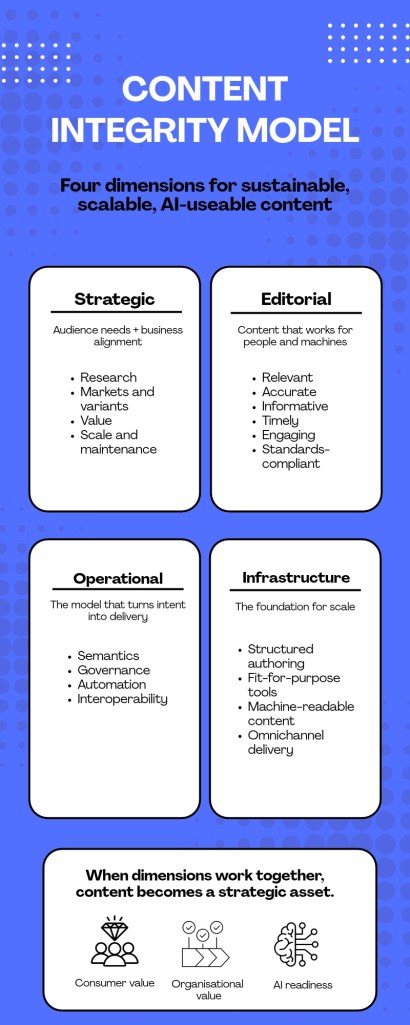
In her 2026 publication, Rahel Anne Bailie introduces the Content Integrity Model, a framework that approaches content as an interconnected organizational system.
Rather than focusing exclusively on editorial quality, the model identifies four dimensions that need to work together:
Strategic: Is the content aligned with organizational goals and audience needs?
Editorial: Is the content accurate, relevant, accessible, informative, and appropriate for its audience?
Operational: Are there processes, standards, and governance structures that support consistent content creation and maintenance?
Infrastructure: Do the technologies and systems support content management, reuse, automation, and scalability?
The important part is that these dimensions aren’t independent.
They’re connected.
An organization might produce beautifully written articles, but if nobody maintains them, their value gradually decreases.
A company might invest in sophisticated content management technology, but without a clear strategy, that technology won’t necessarily solve its communication problems.
And a team might develop an excellent content strategy, but if the people responsible for implementing it lack the necessary resources, the strategy remains theoretical.
The model emphasizes that weaknesses in one dimension can undermine the effectiveness of the others.
I find this particularly interesting because it challenges the way we often divide content work into separate responsibilities.
Writing is one task.
SEO is another.
Social media is another.
Website management is another.
But from the audience’s perspective, these distinctions don’t necessarily exist.
People simply encounter information.
And they expect it to work.
My Experience: When You’re the Entire Content Department
Working in healthcare marketing gave me a practical understanding of how interconnected content really is.
My responsibilities included photography, videography, video editing, social media management, blog writing, and website content.
Some days I was preparing educational content for Instagram.
Other days I was filming medical specialists, editing videos, or working on articles intended to improve the website’s search visibility.
It was a mixture of creative and technical work.
And while I enjoyed having the opportunity to work across different formats, it also made me aware of how easily content can become fragmented.
Imagine producing an educational video about a medical treatment.
You research the topic, prepare questions, film a specialist, edit the footage, and publish it.
Then you write a blog article about the same subject.
You create an Instagram carousel.
You update the relevant service page.
Suddenly, the same information exists in several different places.
At first, that seems like a good thing.
The information is more accessible across different platforms.
But what happens when something changes?
Perhaps the treatment information needs updating.
Perhaps the service details change.
Perhaps the terminology needs to be revised.
Now you have multiple pieces of content that need attention.
And if there isn’t a clear system connecting them, inconsistencies can appear.
This is one of the things that made Bailie’s framework particularly relevant to me.
It helped me understand that content creation isn’t simply about producing information.
It’s also about managing the relationships between different versions of that information.
And when you’re working across several channels, those relationships become increasingly important.
The Internet Has a Maintenance Problem
I think we’re very good at creating things on the internet.
We’re less enthusiastic about maintaining them.
Publishing a new article feels productive.
Updating an article from two years ago?
Not quite as exciting.
There’s no launch announcement.
No new Instagram post celebrating the achievement.
No particularly satisfying moment of pressing Publish for the first time.
But maintenance is one of the most important parts of responsible content management.
Bailie addresses this in the strategic dimension of her model, explaining how maintaining accuracy becomes increasingly complicated as content expands across platforms, languages, and markets.
The more content an organization produces, the more difficult it becomes to ensure that every version remains consistent and up to date.
And I think healthcare provides a particularly good example of why this matters.
Imagine someone searching for information about a medical procedure.
They find an article that appears professional and trustworthy.
The design is modern.
The language is clear.
The information seems comprehensive.
But the article hasn’t been reviewed in several years.
The medical guidance might have changed.
The available treatment options might be different.
The contact information might no longer be accurate.
Suddenly, the quality of the writing becomes less important than the reliability of the information.
A beautifully written article can still be a bad user experience.
And in certain contexts, outdated information can have more serious consequences than simply frustrating a visitor.
This made me think differently about the concept of content quality.
Perhaps quality isn’t something we achieve once.
Perhaps it’s something we have to continuously maintain.
Good Writing Is Only One Part of Editorial Quality
One section of Bailie’s publication that stood out to me was her discussion of editorial integrity.
Traditionally, good content has often been associated with being correct, complete, clear, and concise.
Those are still valuable principles.
But the Content Integrity Model expands the discussion by identifying six editorial qualities:
Relevant. Accurate. Informative. Timely. Engaging. Standards compliant.
These qualities reflect the increasingly complex environments in which digital content exists.
I particularly like the distinction between accurate and informative.
Because something can be technically correct without being particularly helpful.
For example, imagine someone searching for information about a medical consultation.
A website might accurately describe the treatment.
But what if it doesn’t explain how to prepare for the appointment?
What if it doesn’t address common concerns?
What if the information is written in language that assumes the reader already has medical knowledge?
The content might be correct.
But it isn’t necessarily meeting the person’s needs.
And that distinction matters.
During my work in healthcare marketing, I often had to think about how to make complicated medical information understandable without oversimplifying it.
Medical professionals naturally use terminology that might be unfamiliar to the general public.
My responsibility was to help translate that knowledge into accessible communication.
Not by changing the meaning.
But by changing how the information was presented.
Sometimes that meant using simpler language.
Sometimes it meant breaking a topic into smaller sections.
Sometimes it meant choosing a video instead of a written explanation.
And sometimes it meant recognizing that a short Instagram post wasn’t the right format for communicating something complicated.
Looking back, I can see how closely these decisions relate to editorial integrity.
Good content isn’t simply information that’s correct.
It’s information that people can actually understand and use.
Content Governance Sounds Boring. Until You Need It.
I’ll admit something.
When I first encountered the term content governance, it didn’t exactly sound like the most exciting part of content strategy.
Governance sounds administrative.
Rules.
Documentation.
Approval processes.
Responsibilities.
Not exactly the creative side of digital marketing.
But the more experience I gained, the more I started appreciating why these structures matter.
Because without clear responsibilities, content management can become surprisingly chaotic.
Who approves the final version of an article?
Who decides which terminology should be used?
Who updates information when something changes?
Who checks whether content meets accessibility requirements?
Who makes sure different platforms communicate consistently?
When these questions don’t have clear answers, people improvise.
And improvisation can work surprisingly well.
Until it doesn’t.
In her discussion of operational integrity, Bailie argues that governance shouldn’t simply be understood as a restriction. Clear standards and responsibilities can help people make decisions more efficiently and consistently.
I find this perspective refreshing.
Because I think we often imagine creativity and structure as opposites.
Creativity is freedom.
Structure is restriction.
But my experience has taught me that structure can actually make creative work easier.
When responsibilities are clear, you spend less time figuring out what needs to happen next.
When workflows are consistent, you don’t have to reinvent the process every time.
When information is organized, you can focus more energy on communicating it effectively.
Perhaps the purpose of governance isn’t to control creativity.
Perhaps it’s to protect it from unnecessary chaos.
And Then There’s AI
It’s almost impossible to discuss the future of content without mentioning artificial intelligence.
AI has changed how we search for information, generate text, organize knowledge, and interact with digital services.
But I think one of the most interesting questions isn’t whether AI can create content.
We’ve already established that it can.
The more important question might be:
What kind of content are we giving AI to work with?
Bailie’s Content Integrity Model explicitly considers the requirements of AI-usable content.
Her framework emphasizes that information needs more than editorial quality. It also needs appropriate structure, metadata, semantic context, and technical standards so automated systems can process and reuse it effectively.
This introduces a different way of thinking about content creation.
Traditionally, we might write an article primarily for a human reader.
We consider the headline, paragraph structure, tone, and visual presentation.
But in an AI-enabled environment, content may also need to be interpreted by machines.
That doesn’t mean we should stop writing for humans.
Quite the opposite.
It means we need to think more carefully about how information is structured and maintained so that both humans and automated systems can use it appropriately.
Imagine a healthcare website containing hundreds of educational articles.
Some are outdated.
Some use inconsistent terminology.
Some contain contradictory information.
Others lack clear metadata or structure.
Introducing an AI-powered search assistant doesn’t automatically solve those problems.
The assistant may struggle to identify which information is authoritative or current.
AI can make information easier to access.
But it cannot automatically make unreliable source material trustworthy.
And I think that’s an important distinction.
AI doesn’t eliminate the need for content strategy. It makes the consequences of poor content management more visible.
The Invisible Infrastructure Behind Everything
Another part of Bailie’s framework that made me reconsider content management was the infrastructure dimension.
Infrastructure isn’t something most people think about when they visit a website.
They don’t necessarily care which content management system an organization uses.
They don’t see the metadata structures.
They don’t think about how content is stored, versioned, or distributed.
They just want the information they came for.
But behind that experience are systems that determine how efficiently content can be created, managed, and delivered.
Bailie describes infrastructure as the foundation supporting strategy, editorial quality, and operational efficiency. Without appropriate systems, organizations often depend on manual workarounds that become increasingly difficult to maintain.
I can relate to this from working with WordPress and managing content across different platforms.
Something as simple as publishing an article can involve several separate steps.
Formatting the text.
Adding images.
Writing metadata.
Checking links.
Optimizing for search.
Publishing.
Creating promotional content for social media.
Updating related pages.
Each step might seem manageable individually.
But when the same process needs to be repeated across dozens or hundreds of articles, inefficiencies become more noticeable.
And this is where infrastructure becomes a strategic issue rather than simply a technical one.
The tools we use influence how we work.
And how we work influences the quality and sustainability of what we produce.
Something My Master’s Changed About The Way I Think
One of the biggest changes in my thinking during my Master’s was moving away from seeing content as a collection of deliverables.
Before, I often thought about my work in terms of completed tasks.
I filmed a video.
I wrote an article.
I created a carousel.
I published a post.
And those are all legitimate achievements.
But studying content strategy encouraged me to think about what connects those activities.
Why does this content exist?
Who is responsible for it?
How does it support the audience?
How does it relate to other information?
What happens when it becomes outdated?
And what needs to be in place for it to remain useful?
Bailie’s Content Integrity Model gave me a framework for thinking about these questions more systematically.
But what I appreciate most is that it doesn’t present content quality as something that can be achieved through a single checklist.
Instead, it encourages us to consider the relationships between strategy, editorial decisions, operations, and technology.
And I think that reflects the reality of working with content.
Nothing really exists in isolation.
A poorly designed workflow can affect editorial quality.
Unclear organizational goals can influence what gets published.
Inadequate infrastructure can make maintenance unnecessarily difficult.
And a lack of audience research can result in perfectly written content that nobody actually needs.
The challenge isn’t simply to make each individual element better.
It’s to make them work together.
Are We Creating Information or Taking Responsibility for It?
There’s a more philosophical question behind all of this that I keep coming back to.
When we publish something online, what exactly are we responsible for?
Is our responsibility finished once the information is accurate and the article goes live?
Or does publishing something create an ongoing obligation to the people who might encounter it?
I think the answer depends partly on the context.
An outdated restaurant review probably isn’t going to change someone’s life.
Outdated healthcare information might have more serious consequences.
But even outside sensitive industries, digital content shapes how people understand organizations, products, services, and the world around them.
And once information is published, we don’t necessarily control when or how people encounter it.
Someone might discover an article years after it was written.
A social media post might be shared outside its original context.
A piece of information might be summarized by an AI system.
Content travels.
It gets reused.
It becomes disconnected from the circumstances in which it was originally created.
And that makes me think that responsible content creation requires a longer-term perspective.
We shouldn’t only ask whether something is worth publishing today.
We should also ask what needs to happen for it to remain trustworthy tomorrow.
Perhaps that’s what I find most compelling about content integrity.
It shifts the conversation from producing information to taking responsibility for information.
And I think that’s a distinction worth making.
What I Would Do Differently Today
If I were approaching a healthcare content project today, I would spend more time thinking about the systems supporting the content before beginning production.
I would still care about storytelling.
I would still want the videos to look good.
I would still focus on making articles engaging and accessible.
But I would also ask more questions about what happens behind the scenes.
Is there a clear content strategy?
Have we identified the audience’s actual information needs?
Do we have consistent editorial standards?
Who is responsible for reviewing medical information?
How will we manage updates across different platforms?
Can content be reused without creating unnecessary duplication?
And are the tools we’re using appropriate for the work we’re trying to accomplish?
I would also try to create clearer connections between content performance and content quality.
Because an article receiving traffic doesn’t automatically mean it’s helping people.
And a social media post receiving engagement doesn’t necessarily mean it’s communicating responsibly.
Metrics can tell us what people do.
But understanding whether content genuinely serves its purpose requires a broader perspective.
That’s something I want to carry into my future work.
Good Content Needs Good Foundations
I still believe that good writing matters.
So does visual storytelling.
So does creativity.
And I don’t think content strategy should ever lose sight of the human experience of encountering information.
But I’ve come to realize that these visible qualities depend on a much larger system.
A system of decisions, responsibilities, processes, and technologies that most audiences will never see.
And perhaps that’s exactly the point.
When everything works well, people don’t need to think about the infrastructure behind the content.
They simply find what they need.
They understand it.
They trust it.
And they can use it.
Rahel Anne Bailie’s Content Integrity Model helped me put a name to something I’d gradually started noticing through my own professional experience.
Good content isn’t simply created. It’s supported.
Supported by research.
By editorial standards.
By thoughtful workflows.
By appropriate technology.
And by people who recognize that information doesn’t stop being their responsibility once it’s published.
There’s something almost comforting about this perspective.
Because it suggests that content strategy isn’t about chasing perfection in every individual article, video, or post.
It’s about creating the conditions in which quality can be sustained.
And perhaps that’s a more meaningful goal than producing the next perfect piece of content.
Because good content might capture someone’s attention.
But content integrity is what helps it deserve their trust.
What I learned
Exploring the Content Integrity Model helped me connect the theoretical concepts from my Master’s studies with my practical experience in healthcare marketing.
Working across video production, photography, social media, and website content showed me how interconnected content activities can be, but also how easily they become fragmented without clear systems supporting them.
Bailie’s framework encouraged me to think beyond individual deliverables and consider the strategic, editorial, operational, and technical foundations that make content sustainable.
My biggest takeaway is that content quality isn’t only a characteristic of the finished product. It’s also the result of the systems, decisions, and responsibilities behind it.
Reference: Bailie, R. A. (2026). Content Integrity Model: A Framework for Sustainable, Scalable, AI-Usable Content. Content Seriously.


Leave a Reply