I sometimes wonder how many things I’ve scrolled past that I would have genuinely enjoyed.
An interesting article. A beautiful photograph. Someone sharing a story that might have changed the way I think about something.
All gone in less than a second.
Not because they weren’t interesting.
But because I never gave them the chance to be.
There’s something fascinating about the way we consume content today. We move through hundreds of images, videos, headlines, and opinions without necessarily remembering most of them.
Our thumbs seem to make decisions before our brains have caught up.
And somewhere in this endless stream of information, content creators are trying to convince us to stop.
Just for a moment.
Working in social media marketing made me curious about that moment.
What makes someone pause?
Why do certain stories stay with us while others disappear?
And perhaps more importantly, what responsibility do we have once we’ve managed to capture someone’s attention?
The First Three Seconds
Anyone who has worked with short-form video has probably heard some version of the same advice.
You need to hook people in the first three seconds.
Start with a question.
Make a bold statement.
Create curiosity.
Show something unexpected.
And there’s a reason this advice exists. On platforms where people can move to the next piece of content with a single movement of their thumb, the opening moments matter.
But I’ve always found the word hook a little strange.
It makes attention sound like something we need to catch.
As if the audience is a fish and our content is bait.
The more I worked with social media, the more I started questioning that idea.
Because there’s a difference between making someone curious and manipulating them into watching.
A dramatic headline might stop someone scrolling.
But does it give them anything valuable?
A controversial statement might generate hundreds of comments.
But does that mean the communication was successful?
I started thinking that the real challenge wasn’t simply capturing attention.
It was earning the right to keep it.
The Psychology of a Click: Youtube Thumbnails

I think YouTube thumbnails are one of the most fascinating examples of how attention works online.
Think about how we choose what to watch on YouTube. We rarely read every video title carefully or spend much time evaluating the content. Instead, we scan a collection of images, and something catches our eye.
Maybe it’s an exaggerated facial expression, a dramatic before-and-after comparison, a mysterious object, or three words in enormous yellow letters.
Sometimes I find myself clicking on videos I wasn’t even interested in watching five seconds earlier.
And I think that’s fascinating.
A thumbnail is essentially a promise. It tells us that if we give this video our time, we’ll receive something in return. Entertainment, information, an answer, or perhaps simply the satisfaction of resolving our curiosity.
But there’s also something slightly absurd about how thumbnails have evolved.
People making shocked faces at things that probably aren’t particularly shocking. Red arrows pointing toward completely ordinary objects. Titles suggesting that something unbelievable happened, only for the video to reveal something rather underwhelming.
We’ve become so accustomed to these visual exaggerations that they almost feel like their own language.
And the strange thing is that they work often enough for creators to keep using them.
But this brings me back to the distinction between capturing attention and deserving it.
A thumbnail might convince someone to click, but it can’t guarantee they’ll stay. If the content doesn’t deliver on what the image promised, that initial curiosity can quickly turn into disappointment.
To me, this illustrates something important about content strategy: the first impression and the actual experience need to belong to the same story.
A good thumbnail doesn’t have to reveal everything. Curiosity is part of what makes storytelling interesting. But there’s a difference between leaving something unanswered and deliberately creating a misleading expectation.
And I think that distinction applies far beyond YouTube.
It applies to Instagram hooks, article headlines, email subject lines, and almost every other moment when we’re asking someone to give us their attention.
Because getting someone to click is relatively easy compared to making them feel that clicking was worth it.
What Healthcare Marketing Taught Me About Attention
Creating social media content for healthcare introduced an interesting challenge.
Medical information isn’t always naturally entertaining.
Some topics are complicated.
Others are sensitive.
And many require more explanation than a thirty-second video can comfortably provide.
Yet the platforms we use to distribute this information often reward speed, simplicity, and immediate engagement.
I found myself working between two very different expectations.
On one side was the need to communicate accurate, responsible information.
On the other was the reality of social media, where content competes with entertainment, personal stories, advertisements, and everything else happening in someone’s feed.
As a videographer, editor, and social media manager, I had to think carefully about how information was presented.
A doctor’s explanation might be informative but too long for Instagram.
A blog article might contain valuable information but need a different introduction to work as a carousel.
A medical topic might be important without having an obvious visual element.
These challenges forced me to think beyond simply making content shorter.
I needed to consider what made the information meaningful to the audience.
What question was the video answering?
Why would someone care?
Could the main point be communicated without losing important context?
And was social media even the right place for the entire explanation?
Sometimes the best solution was using a short post to introduce a topic and directing people toward a more detailed article.
The social media post didn’t need to contain everything.
It needed to create a useful beginning.
Curiosity Is a Powerful Thing
I think curiosity is one of the most underrated parts of content strategy.
Not because it’s a clever marketing technique.
But because curiosity is one of the reasons people seek information in the first place.
We notice something unfamiliar.
We encounter a question we can’t immediately answer.
We recognize a problem we’ve experienced ourselves.
And suddenly, we want to know more.
Good storytelling understands this.
It doesn’t necessarily reveal everything immediately.
It creates a reason to continue.
Think about the difference between these two headlines:
“Information About Hormone Therapy”
and
“What Actually Happens During Hormone Therapy?”
Both introduce the same general topic.
But the second creates a clearer expectation.
It promises an answer to a specific question.
And that makes it easier for someone to decide whether the content is relevant to them.
This isn’t about making exaggerated promises.
It’s about understanding the difference between describing a subject and communicating its value.
A headline shouldn’t simply announce that information exists.
It should help someone understand why that information might matter.
The Difference Between Being Seen and Being Remembered
Social media metrics can tell us a lot.
How many people saw a post.
How long they watched a video.
Whether they clicked a link.
How many times they shared something.
But there’s something these numbers don’t fully capture.
What stayed with the person afterward?
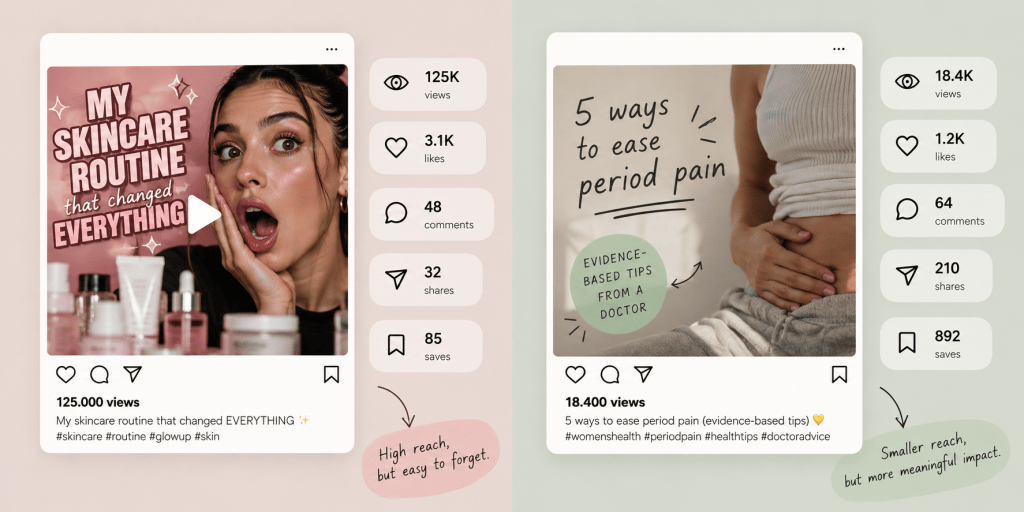
A video might receive thousands of views and be forgotten almost immediately.
Another might reach a much smaller audience but leave someone thinking about the topic hours later.
I don’t think these outcomes are necessarily equal.
And yet, from a purely performance-driven perspective, the first video might appear more successful.
This made me increasingly interested in the difference between visibility and meaning.
Being seen is important.
But being remembered often requires something more.
A story.
A feeling.
A useful insight.
A moment of recognition.
Something that connects the information to a person’s existing understanding of the world.
Perhaps that’s why storytelling remains so important, even in highly technical fields.
People don’t always remember isolated facts.
But they often remember the context that made those facts meaningful.
The Problem With Chasing Trends
One of the easiest ways to feel behind in social media marketing is to open Instagram and see how quickly everything changes.
A new trending audio.
A new editing style.
A new format.
A new recommendation about what the algorithm supposedly prefers.
There’s always something else to try.
And trends can be useful.
They provide familiar formats that audiences already understand.
They can make content feel current and approachable.
But I also think they create pressure to participate in conversations that aren’t always relevant.
Not every brand needs to use trending audio.
Not every educational topic needs to become a meme.
And not every organization benefits from trying to sound like a twenty-year-old on TikTok.
Especially in healthcare, where credibility and sensitivity matter, following a trend without considering the context can create more problems than opportunities.
I learned that the important question isn’t whether a format is popular.
It’s whether that format helps communicate the message.
Sometimes it does.
Sometimes it doesn’t.
And knowing the difference is part of the strategy.
Design Is Also a Form of Communication
As someone who worked with photography and video, I became increasingly aware of how visual decisions influence attention.
Composition.
Lighting.
Colour.
Movement.
Typography.
Even the amount of empty space around an element.
These choices affect how information is perceived before someone has consciously processed the words.
A cluttered graphic can make a simple explanation feel complicated.
A poorly framed video can distract from an otherwise interesting conversation.
A thoughtful photograph can communicate warmth and familiarity without needing a caption to explain it.
But visual appeal alone isn’t enough.
An attractive post can still be confusing.
A beautifully edited video can still lack a clear purpose.
This is where I think content strategy and visual communication become inseparable.
Design shouldn’t exist merely to decorate information.
It should help people understand it.
The most effective visuals don’t always demand attention.
Sometimes they simply make the information easier to process.
Are We Creating Content or Competing for Attention?
The more I think about social media, the more I find myself questioning the idea that every piece of content needs to compete.
We talk about winning attention.
Beating the algorithm.
Increasing engagement.
Standing out.
And of course, organizations need visibility to communicate effectively.
But I wonder whether constantly approaching content as a competition changes the way we create it.
When the primary goal becomes stopping someone from scrolling, it’s tempting to prioritize whatever produces the strongest immediate reaction.
Surprise.
Fear.
Controversy.
Exaggeration.
These techniques can work.
But they can also make digital spaces feel exhausting.
I don’t think every post needs to interrupt someone’s day.
Some content can simply be useful.
Some can be quiet.
Some can provide information without demanding an emotional reaction.
And sometimes a person scrolling past doesn’t mean the content failed.
It might simply mean the information wasn’t relevant to them at that moment.
That’s not necessarily a problem.
What I would Do Differently Today
Looking back at my experience creating social media content, I think I would spend even more time considering what happens after the initial moment of attention.
Instead of asking only whether a video has a strong opening, I would ask whether it delivers on the promise that opening creates.
Instead of focusing exclusively on engagement, I would look more closely at whether the content encourages meaningful actions.
Does someone save the post because they might need the information later?
Do they visit the website to learn more?
Does the content answer a question clearly?
Does it make a complicated topic easier to understand?
I would also experiment more deliberately with different storytelling approaches.
Not simply to discover which format receives the most views, but to understand which format communicates a particular type of information most effectively.
Because a short educational video, a carousel, and a long-form article serve different purposes.
The goal shouldn’t be to make every message fit the same format.
It should be to choose the format that serves the message.
Attention is Borrowed
There’s something almost philosophical about the relationship between content and attention.
Every time someone watches a video, reads an article, or pauses on a photograph, they’re giving us something they can never get back.
A small piece of their time.
And in a digital environment designed to keep people moving from one thing to the next, that feels increasingly significant.
As content creators, we often talk about attention as something we want to capture.
But perhaps we should think about it as something people choose to give us.
That changes the responsibility.
If someone spends thirty seconds watching an educational video, those thirty seconds should be worth something.
If they click on an article, it should deliver what the headline promised.
If they stop scrolling, there should be a reason beyond our desire for another impression.
Working in social media marketing taught me that understanding attention is important.
But respecting it is even more important.
Because the goal shouldn’t simply be to make people stop scrolling.
It should be to give them something worth stopping for.


Leave a Reply